
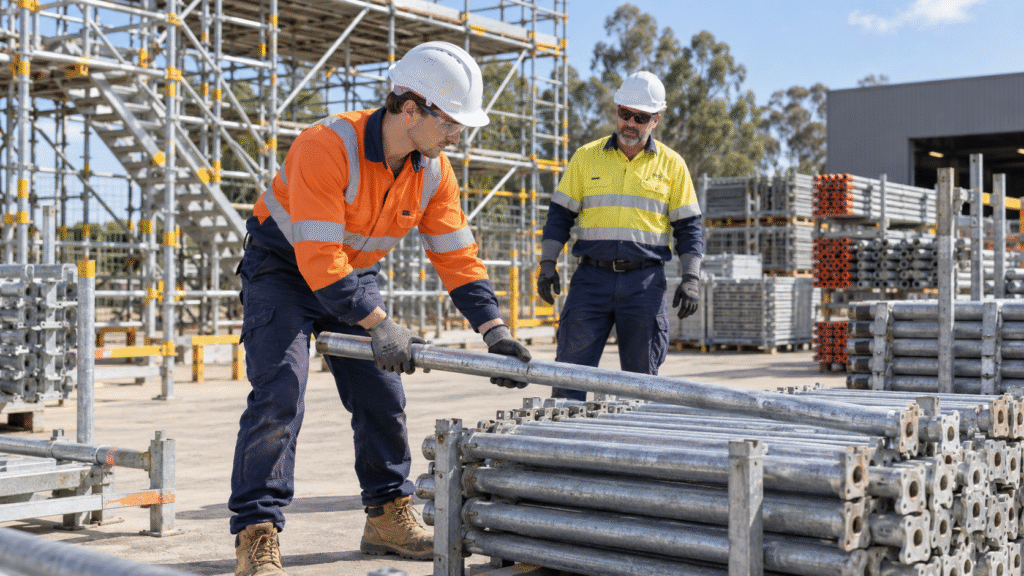
Before you ever climb a scaffold with a spanner on your belt, there is a lot to learn on the ground. A good scaffold ground labourer keeps the job moving, helps the licensed scaffolders work safely and starts building the habits that matter throughout a scaffolding career.
People sometimes look at the ground role as if it is only carrying gear. It is much more than that. You are learning the names of the components, the order in which they are needed, how the work area is controlled and how a crew communicates. Done well, the role gives you a strong foundation for moving into basic scaffolding.
Starting the day
The day usually starts with the job plan, site conditions and the hazards around the work area. Before gear is moved, the crew needs to understand what is being built, where it will stand, how materials will arrive and who may be affected by the work.
- Confirm the work area, access route and material laydown area
- Check for traffic, pedestrians, overhead services and changing ground conditions
- Help establish exclusion zones and keep unauthorised people clear
- Listen to the scaffold plan and the sequence the licensed scaffolder intends to use
A tidy start saves time later. If components are mixed together, stacked badly or placed in the wrong order, the crew ends up double handling equipment. That wastes energy and can introduce avoidable risks.
Knowing the gear
A ground labourer needs to recognise the system and its parts. Depending on the scaffold, that may include standards, ledgers, transoms, braces, base plates, adjustable jacks, sole boards, platforms, guardrails, midrails, toeboards, ladders and ties.
You do not need to pretend you know everything on day one. Ask what each component is called, what it does and when it will be needed. The quicker you can select the correct item and pass it safely, the better support you provide to the crew.
Practical setup tip
When laying out ledgers, leave roughly 100 mm between them so there is room for the standards. Small layout habits like this make the first bay easier to establish and reduce unnecessary handling.
Moving and passing materials
Scaffold components are repetitive, awkward and often handled for hours at a time. Good manual handling is not just one perfect lift. It is planning the whole movement, keeping travel paths clear, sharing heavy or awkward loads and avoiding the temptation to rush.
- Use a stable stance and keep the load controlled
- Ask for help with long, heavy or awkward components
- Never throw gear unless a site-specific safe system expressly permits a controlled method
- Pass components only when the receiver is ready and communication is clear
- Stack gear securely so it cannot roll, slide or block access
Communication keeps the crew moving
On a scaffold job, unclear communication creates risk. The groundie needs to listen, repeat instructions when needed and speak up if something changes. If a pedestrian enters the exclusion zone, the ground shifts, a delivery blocks access or a component looks damaged, say so immediately.
Good crews do not rely on guessing. They use agreed words and signals, maintain eye contact where possible and stop when the message is not understood.
Housekeeping is part of the job
Housekeeping is not something left until the end. It happens throughout the shift. Keep loose components organised, remove packaging and trip hazards, protect emergency access and make sure the next item can be reached without climbing over a pile of gear.
A clean laydown area also makes stock control easier. The crew can see what is available, what is missing and whether damaged equipment has been isolated.
Know the licence boundary
Ground labouring can give you valuable experience, but it does not replace the required high risk work licence. Scaffolding work where a person or object could fall more than four metres must be carried out by, or under the appropriate supervision of, people who hold the required scaffolding licence. Site rules and other legal duties still apply at lower heights.
Your role is to support the work within your training, instructions and authority. If you are unsure whether a task is within your role, stop and ask the supervisor or licensed scaffolder.
Building a pathway into scaffolding
The best ground labourers are observant. They learn the component names, watch the build sequence, understand why the first bay matters and take safety controls seriously. That experience can make formal training easier because the equipment and work environment are no longer unfamiliar.
A common pathway begins with a White Card for construction work, site experience in a ground role and then formal Basic Scaffolding training when you are ready. Working Safely at Heights training can also strengthen your understanding of fall hazards and controls, but it does not replace a scaffolding high risk work licence.
Ready for the next step? FACT Adelaide delivers practical White Card, Working Safely at Heights and Basic Scaffolding training. Contact us to discuss the right starting point for your experience and work goals.
General information only. Always follow current workplace procedures, equipment instructions, site requirements and applicable legislation. This article is not a substitute for formal training, supervision or assessment.