
By Allan Bartlett, FACT Adelaide.
You can normally tell within the first ten minutes what sort of scaffold job you are going to have.
Where has the truck dropped the gear? How far is it from the building? Is the site flat, or are you carrying equipment uphill? What is the soil like? Has the crane crew turned up? Is it pouring with rain? Is the building a straightforward rectangle, or are you already looking at garages, roof lines and awkward offsets thinking, this is going to be a hard one?
After enough years scaffolding, you start reading a site almost immediately. A lot of whether the job goes well or badly comes down to what happens before the scaffold gets very far off the ground.
This article follows on from Know Your Scaffold: Can You Identify the System and the Parts? and our earlier practical scaffolding tips and knowledge quiz.
Before you unload anything, work out where the gear is going
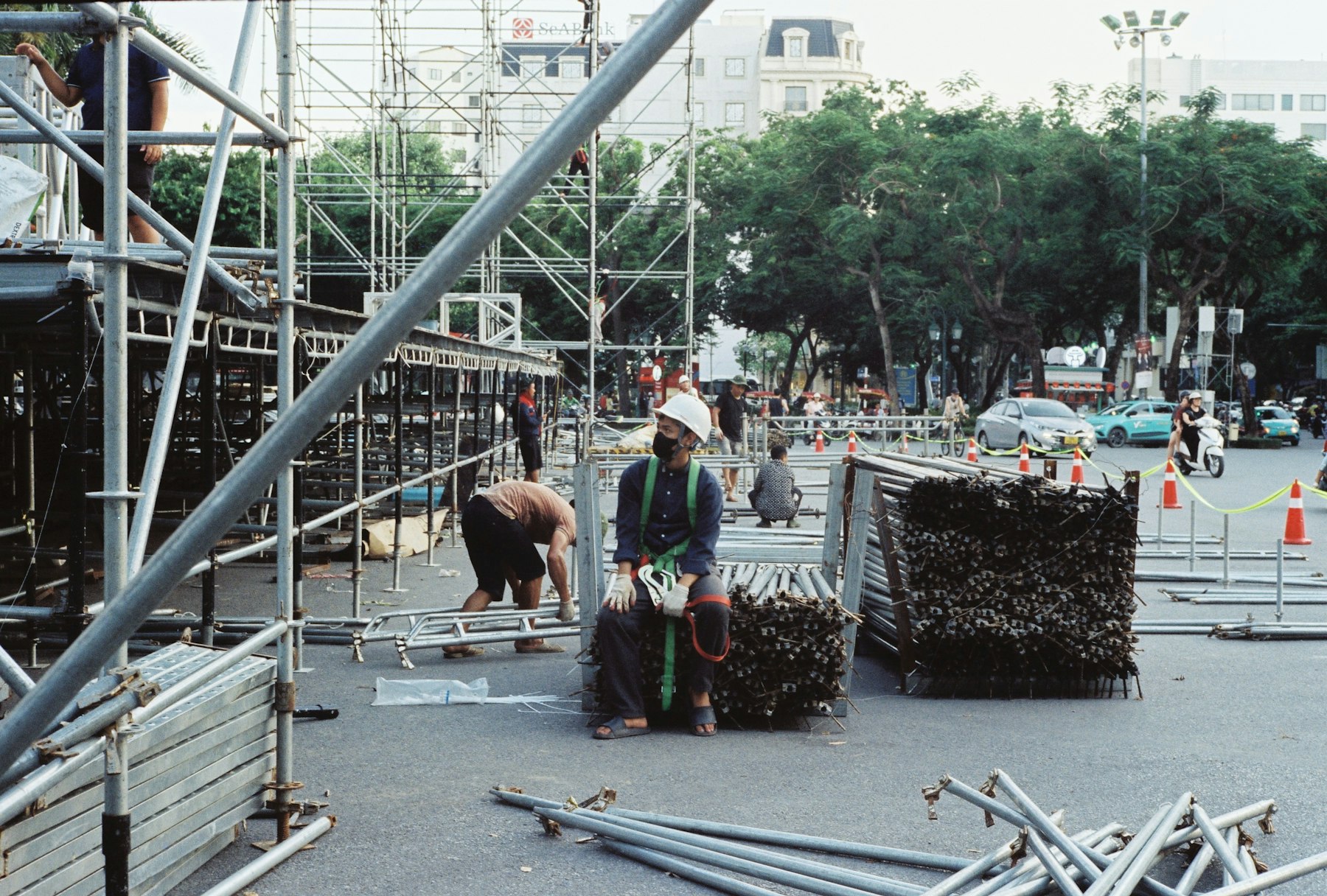
On a domestic house job, you may have five or six stillages of equipment before you even start. You could have stillages of transoms and ledgers, standards, fittings, short tubes, screw jacks, sole boards and two or three pallets of steel boards.
Steel boards alone take up a fair amount of room. What looked like an open site can quickly become crowded once scaffold gear, brick packs, timber and other trades are all trying to use the same space.
So before the truck starts dropping everything wherever it can fit, think ahead. Where is the scaffold actually going? Where are you going to lay the gear out? Can the crew move between the equipment and the building without climbing over bricks, rubbish and other trades’ materials?
Walk the scaffold line first
One of the first things I would do is walk the proposed scaffold line. You are looking at the ground, access, building shape and what is already in the way.
Is the surface reasonably flat? Is the ground firm? Are there piles of building waste along the wall? Are pallets or equipment sitting where the scaffold needs to go? Is there enough room to work safely around it?
The ground underneath the scaffold matters
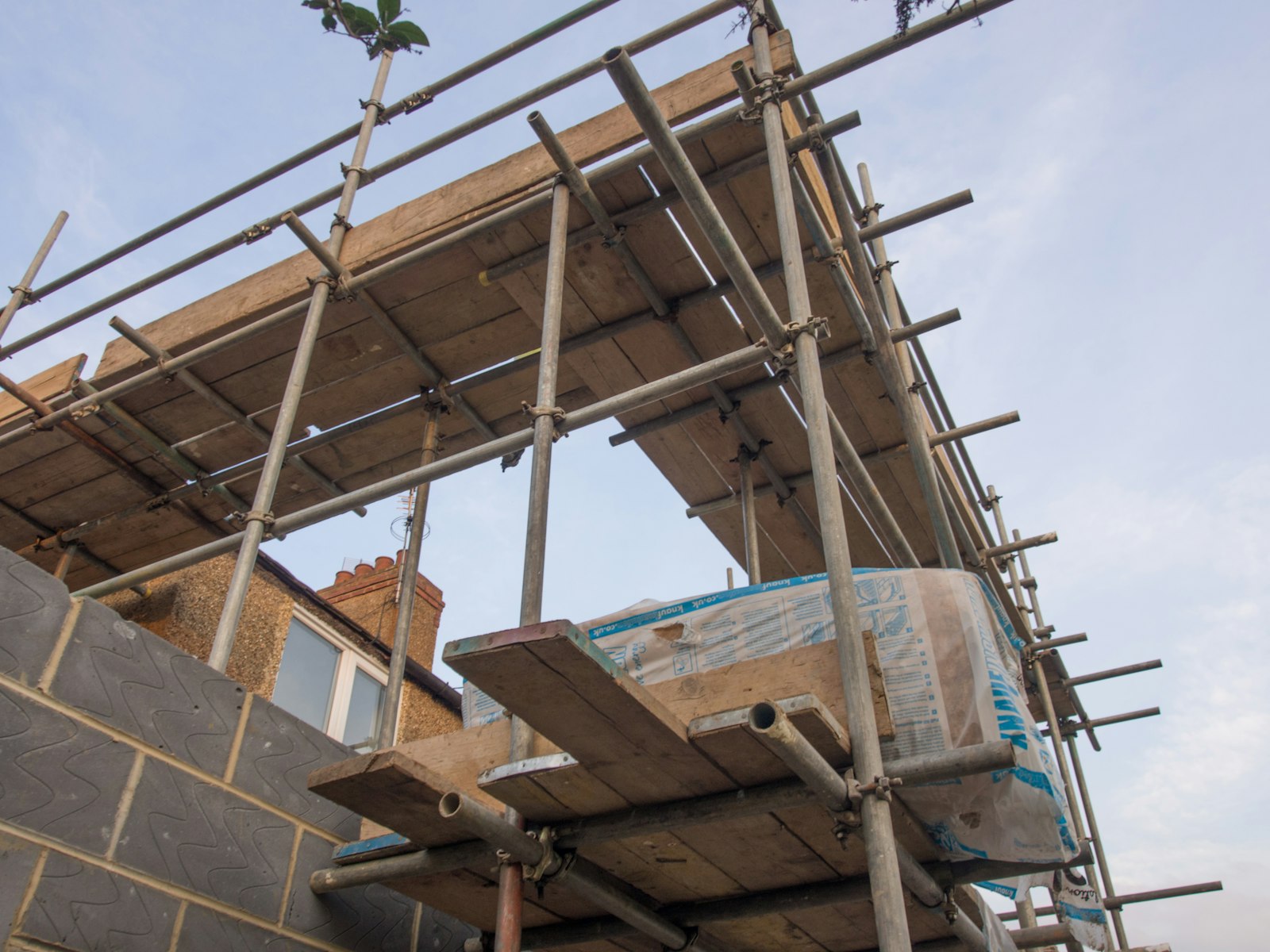
The scaffold needs a stable base. Concrete is different from compacted ground. Compacted ground is different from soft fill. Wet ground is different from dry ground.
If the support underneath the scaffold settles, slips or moves, the scaffold above can move as well. Small errors at ground level become harder to deal with as the scaffold progresses.
Safe Work Australia guidance says scaffold foundations should carry and distribute the full scaffold load, and that ground conditions and weather, particularly wind and rain, should be considered when preparing the foundation. Read the Safe Work Australia scaffold guide.
What does a sole board actually do?
A sole board helps distribute the scaffold load into the supporting surface. Rather than the load being concentrated through one small point, the board spreads that load over a greater area.
Ground bearing pressure is something scaffolders learn about because the surface under the scaffold matters. The required sole board size and arrangement depends on the supporting surface, the scaffold and its design, so it is not something to guess.
Safe Work Australia also notes that soleboards and baseplates should be level and that adjustable bases can be used on uneven surfaces for modular scaffold systems to provide a level base lift.
Look up as well as down
Site setup is not only about the ground. You also need to know what is happening above and around the work area.
Working below suspended loads is a serious hazard. Powerlines are another major issue because scaffold components are conductive and dangerous arcing or flashover can occur without direct contact.
SafeWork SA warns that tiger tails are visual indicators only. They do not insulate the line, and current safe approach requirements still have to be maintained. Isolation or other controls may be required depending on the job. Read SafeWork SA’s powerline warning.
Follow the scaffold drawing
You do not randomly choose scaffold dimensions when you arrive on site. You follow the scaffold drawing or plan.
That matters because the plan gives you the layout and dimensions the scaffold is supposed to follow. Sometimes the actual building is not exactly what everyone expected. Buildings can be slightly shorter, longer or different from the original information. An experienced scaffolder may identify a practical problem, but any required change needs to be dealt with properly rather than simply changing the design because it seems easier.
The first bay matters more than people realise
Once you start the scaffold, the first bay needs to be right. Level, square and in the right position.
If the first bay is wrong, you can carry that error into everything you build afterwards.
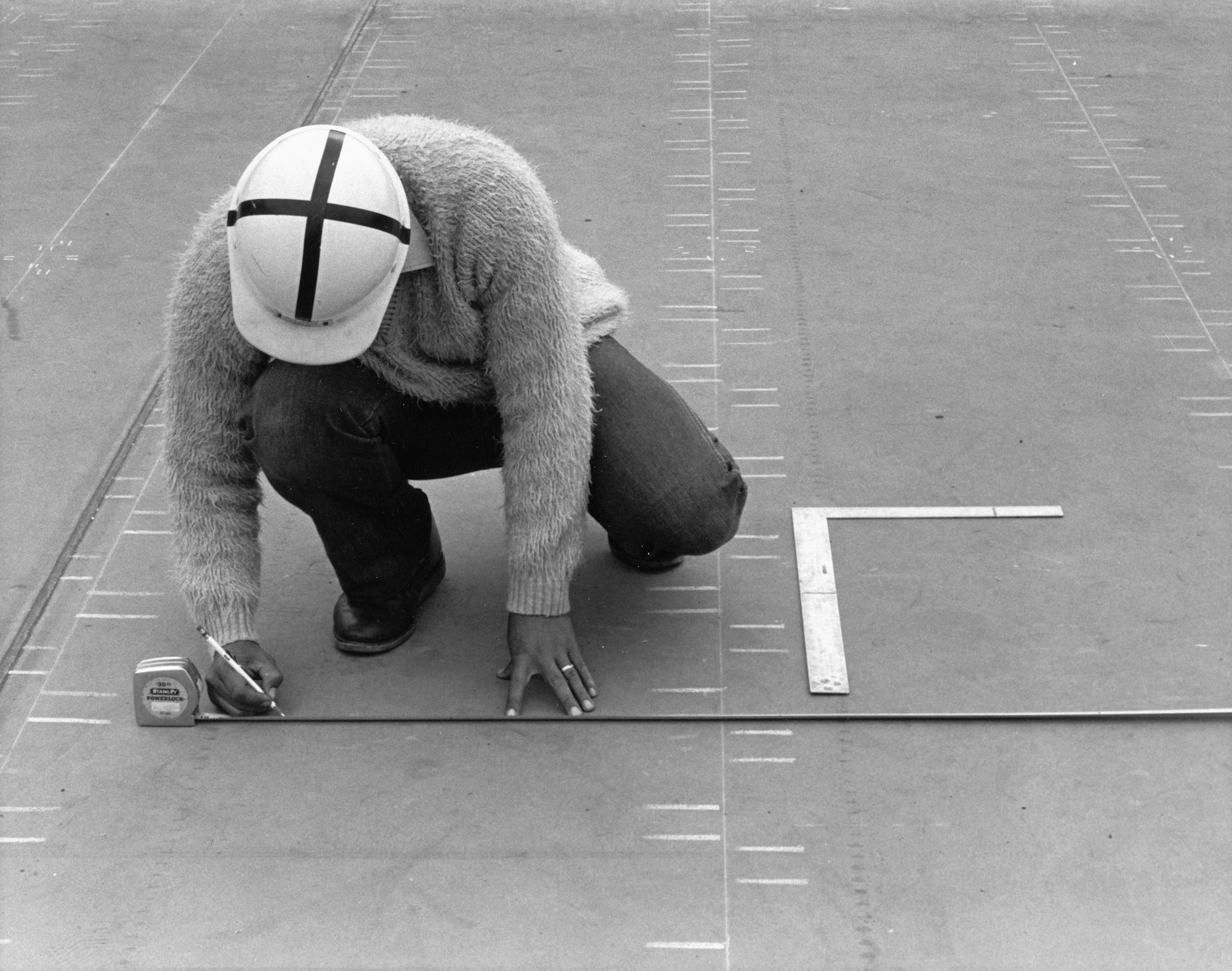
A straightforward way to check a rectangular bay for square is to compare the two diagonal measurements. Measure from one corner to the opposite corner, then repeat across the other diagonal. If the measurements match, the bay is square.
An experienced scaffolder can often see when it is wrong
A steel scaffold board can give you a quick visual clue. When you place the board into the bay and look at the gap between the board and the transom, the gap should look reasonably consistent.
If you can comfortably get a finger into the gap at one end but barely fit it at the other, something is probably out. The board does not replace the proper measurement. You still check. Experience simply helps you notice problems sooner.
Lay the gear out properly and avoid double handling
One of the easiest ways to waste time is to put the equipment in the wrong place.
When I was laying out a run, I would use the first ledger to establish where the bays were going. Then I would leave space between the laid-out ledgers for the standards. On the systems I worked with, around 100 mm was a practical layout habit that helped keep the gear in the right place as we based out. That is an experience-based setup method, not a universal scaffold dimension, and the system plan and instructions always come first.
If everything is laid hard together, several bays later you can find the gear is no longer where you need it. Then somebody has to pick it up and move it again.
That is double handling. It costs time and increases manual handling. Every standard or ledger you unnecessarily pick up twice is extra work your body did not need to do.
A good groundie makes the whole crew faster
Scaffolding is teamwork. If I am working backwards along the building erecting bays, I want the next set of gear already laid out behind me.
A good groundie is integral to the scaffold crew. They are laying out gear, moving components, passing equipment up and making sure the right component is where the scaffolder needs it.
It is physical work, and in many ways it is one of the hardest jobs on the crew. A good groundie needs to be switched on, organised, ready to work and able to stay ahead of the erection crew.
Work smart, not stupid
One of the first things I would teach somebody new is not to overload themselves. You do not need to prove how strong you are by trying to carry half the scaffold in one trip.
There is a saying I like: slow is smooth, smooth is fast.
If you rush, you make mistakes. If you make mistakes, you have to go back and fix them. That often costs more time than doing the job properly in the first place.
Roxby: when the first bay makes the rest easier
I remember a job at Roxby where we were building tube-and-fitting scaffold through pipework so laggers could access the pipes and work on the insulation.
It was awkward work, with pipework everywhere and mine-site expectations for the finished scaffold. The first bay was critical. Once that first section was properly set up, level, square and where it needed to be, the rest of the scaffold started to flow.
The time spent getting the start right was not wasted. It saved time later.
Brighton: when poor planning turns hours into days
I remember another job on the Esplanade at Brighton. It was a beautiful house with an indoor swimming pool that continued into an outdoor pool.
The pool was not finished, so we were trying to build scaffold through and around that area. The coordination had not been done properly and the equipment that arrived did not suit what we were trying to build.
We were mixing equipment, waiting for trucks to bring additional gear and needing approval before modifying tube. What should probably have taken hours ended up taking days.
Sometimes the biggest scaffold problem is not the scaffold. It is poor planning and poor communication before the crew arrives.
What would I teach somebody new?
If somebody had just completed their White Card and was starting around scaffold, I would not expect them to know everything.
I would want them to listen, learn the names of the components, learn how to carry them properly, watch how experienced scaffolders lay gear out and understand why the first bay matters.
When teaching somebody to check square, I would often let them work the tape. We would measure one diagonal, then the other, compare the readings and talk through what needed to move. Those small lessons are how trade knowledge gets passed on.
A White Card gives you the general construction safety foundation. It does not make you a scaffolder. Experience comes from proper training, supervision and time on the job.
Build your construction-safety skills with FACT Adelaide
Working Safely at Heights Adelaide
Basic Scaffolding course information
This article is general educational information based on practical scaffolding experience. Scaffold erection must follow applicable legislation, site requirements, scaffold design information, manufacturer instructions and competent supervision.
Image credits: Troy Mortier, Khanh Do, Brett Jordan, Ricardo Gomez Angel and Navy Medicine via Unsplash.